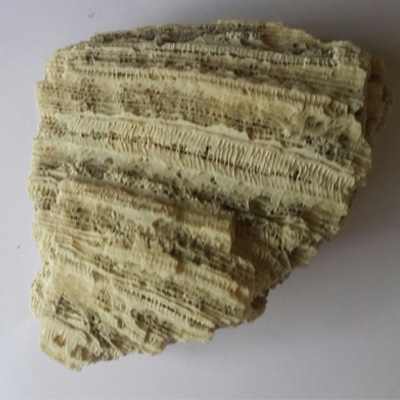
Description
The stones containing pumcite rocks generally flows over water for some moments. Like the volcanic rocks generally flows in water and travel to a distance of 300 to 400 km. Pumcite has an average porosity of 90%. Pumcite is the name given to the hardened foam of lava when it comes out of a volcano. The inside of a volcano has very high pressure, and can be as hot as 1600 degree Celsius. When the lava comes out of the volcano, it meets the cool air and sometimes sea water, which is around 25 degree Celsius. Air and water that were mixed in the lava bubble out, as the pressure falls. The huge difference in temperature gives the lava a ‘cold shock’, so it freezes almost immediately. So the bubbles get trapped in the freezing stone, giving it a very spongy appearance. In some kinds of pumcite, the bubbles can make up to 90% of the volume. But because the stone is full of air bubbles, it is less dense than water. So in the beginning it will float. But in time, water will enter the bubbles driving out the air. Slowly, the stone sinks.
Some floating stones are found on the coastal regions of Mediterranean sea. These stones are dissimilar to any other stone and possess different features, physical and chemical composition like the stone you may find in your locality. Seeing these stones from a far distance, you may feel that those are very unique.